
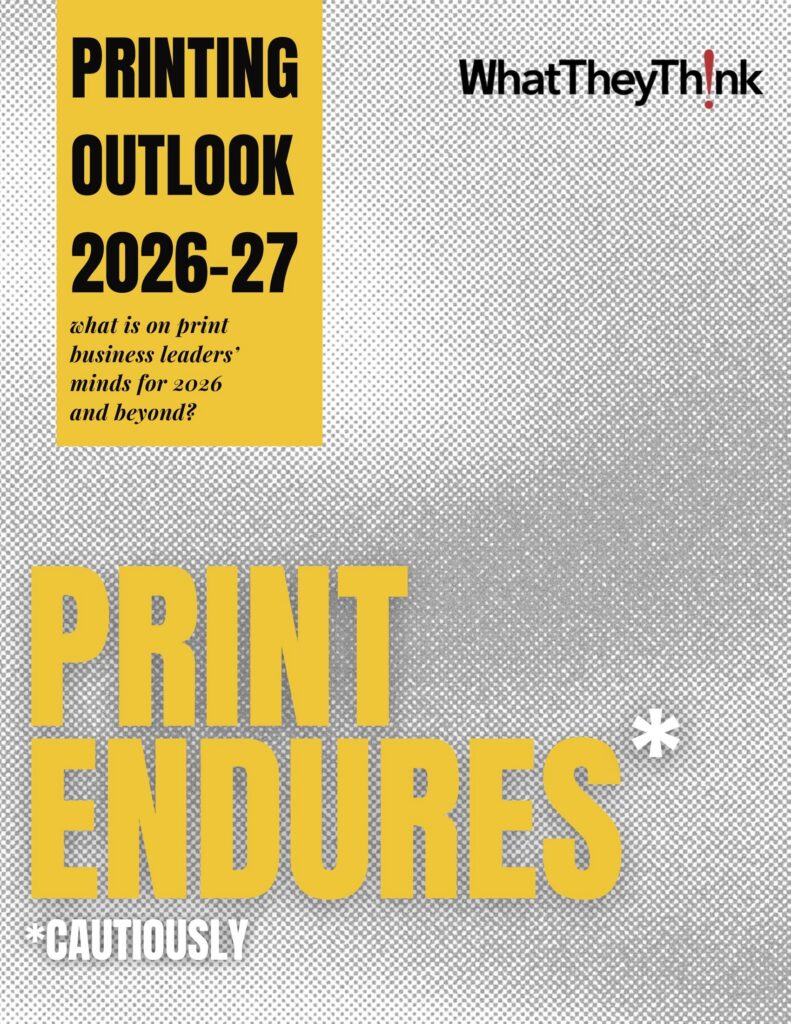
 The Printing Outlook 2026–27 report provides detailed analysis of the latest WhatTheyThink Printing Industry Survey, the latest industry economic data and macroeconomic trends, as well as industry and cultural technological trends to look out for in the latter half of 2026 and beyond.
The executive report was prepared by Richard Romano and looks back at 2025 and the first few months of 2026 and ahead to what the industry can expect, economically and technologically, in the latter half of 2026 and into 2027 and beyond. The report features the results of the WhatTheyThink Printing Industry Business Outlook Survey conducted in Fall 2025/Winter 2026, and includes current and expected business conditions, top business challenges, top business opportunities, and planned investments for 2026. Additional questions asked about shops’ hiring plans for the next 12 months, the current state of automation, and the extent to which print businesses are implementing artificial intelligence (AI), and for what.
This year’s report utilized a different type of survey than past reports have used, and we captured extensive qualitative data on what truly is on the minds of many print business owners.
The report also offers the latest government data on printing industry shipments, establishments, profits, and employment, as well as the economy in general, and includes an industry forecast to 2035, as well as some technology and cultural trends the industry should prepare itself for in 2026 and 2027.
Report highlights:
- 23% of print businesses surveyed said that revenues for 2025 had increased more than 10% compared to 2024.
- Profitability lagged behind revenues.
- “Pricing pressures and price erosion” was our survey respondents’ number one challenge, with “national economic conditions” a close second.
- Geopolitical issues were of greater concern in this survey than in the history of our Outlook reports.
- “Diversifying print product/application offerings” and “customers outsourcing more work to us” were respondents’ top business opportunities for 2026.
- There appears to be a disconnect between print businesses that see diversification as an opportunity and concrete plans to invest in new equipment or identify new capabilities to add.
- Just about one-half of survey respondents said they plan to hire staff in 2026, primarily production staff.
- Two-thirds of survey respondents said they have implemented some kind of workflow automation.
- One-third (32%) of survey respondents say they use artificial intelligence now in some fashion—10% “actively.”
Print business owners will find the report essential for their planning in order to put the marketplace and their strategic actions in realistic perspective. Industry suppliers will benefit from the insights into printer decision-making processes and the foundation of new industry demographic data that debuts in this report. Non-economic trends also offer ideas for what to pay attention to in the new year, and larger cultural and technological; trends indicate where marketing professionals and brandowners will likely be focusing their promotional dollars.
What’s included in this report
Section 1 presents our Fall 2025/Winter 2026 survey data about current (2025) and expected (2026) business conditions, specifically how print businesses fared vis-à-vis revenues, number of orders, and profits.
Section 2 presents our survey data on print businesses’ top challenges, opportunities, and planned investments.
Section 3 looks at print businesses’ hiring plans. Do they have any and, if so, for which positions?
Section 4 looks at automation and so-called “artificial intelligence.” Have print businesses implemented some kind of workflow automation? If so, what do they think of as “workflow automation”? We also asked if print businesses were using AI (or, more appropriately, “machine learning”) for any of their business or production tasks.
Section 5 rounds up a variety of printing industry data—establishments, shipments, profits, employment, and so on. In addition to commercial print, we also include data on publishers, sign and display advertising shops, and several categories of paper and packaging converters.
Section 6 provides the latest general macroeconomic data. These data are important to put industry data into the proper macroeconomic context.
Section 7 offers what we see as the dominant trends for the latter half of 2026 and intio 2027 and beyond, as well as WhatTheyThink’s economic and printing industry forecast.
The demographics of the respondents who completed our survey are included in Appendix A. Our entertaining explanation of survivor bias is presented in Appendix B.